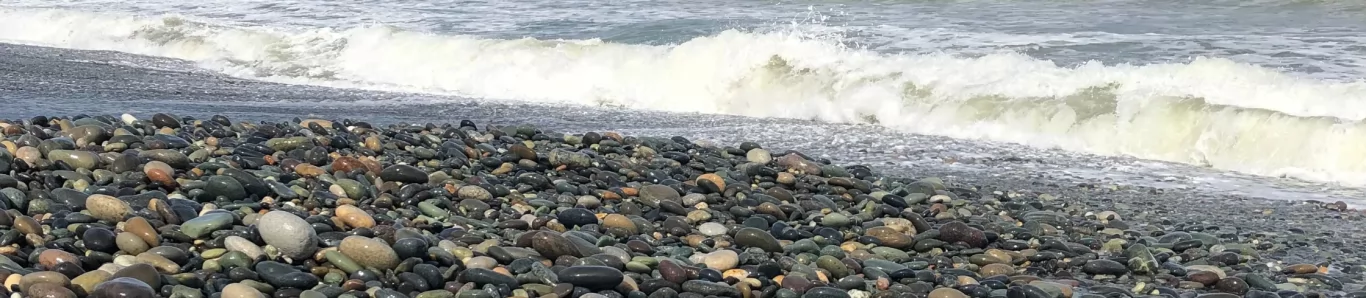
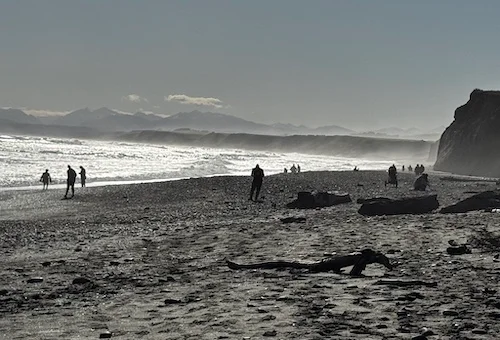
An update post to my previously published post My Thoughts on Gemstone Beach Mining Application.
Many email inboxes received the same “canned” reply from their objection email to NZPAM today. I’ve posted the reply below for convenience and transparency. One may wonder what was the point in objecting after reading it but I think it’s safe to say NZPAM was inundated with objections. They are now most aware of the public interest and adverse reaction to this mining application. Environment Southland plus the Southland District Council are also well aware of the public outcry about this application too.
NZPAM’s reply:
Kia Ora.
Thank you for your correspondence regarding permit application 61382.01, which is currently under evaluation by New Zealand Petroleum and Minerals (NZP&M).
NZP&M administers the Crown Minerals Act 1991 (CMA), which governs the allocation of rights to prospect for, explore, and mine Crown-owned minerals in New Zealand. You can read more on the legislation we administer at Legislation we act under – New Zealand Petroleum and Minerals.
When assessing an application, NZP&M can only apply the statutory tests set out in the CMA. This includes an applicant’s proposed work programme, technical and financial capability, compliance history and a high-level assessment of an operator’s health and safety capability.
The CMA does not allow us to consider public submissions as part of our assessment.
You can keep up-to-date on the status of this permit application via our Online permitting system – New Zealand Petroleum and Minerals.
Ngā mihi
New Zealand Petroleum & Minerals
Resource Markets Branch
Ministry of Business, Innovation & Employment
[email protected] | Telephone: 0508 263 782 (within New Zealand); +64 3 962 6179 (from overseas)
It might be time to start a petition! As more information comes to light about this particular application to mine “quartz, garnet and gemstones”, more reasons to stop this application come to mind:
Disproportionate Privilege
This application would give one person exclusive legal control over resources that have always been collectively enjoyed. It creates an unfair imbalance where the gain is private, but the loss is public.
Loss of Shared Experience
Gemstone Beach is famous because anyone can wander its shoreline, pick up a few stones, and take home a memento of Southland. Handing exclusive mineral rights to one individual undermines this shared experience. A single permit holder shouldn’t decide what others can and can’t take.
Undermining Tourism Appeal
Thousands of New Zealanders and international visitors stop at Gemstone Beach each year precisely because it’s free, open, and accessible. Restricting fossicking rights would damage the beach’s reputation as a place where “everyone can find a gem.” Local businesses from Manapouri to Tuatapere to Orepuki to Riverton could feel the ripple effects.
Conflict With Southland’s Tourism Identity
Southland promotes itself on natural beauty, wild landscapes, and open access. Allowing exclusive gemstone rights sends the opposite message: that treasured places can be carved up for private benefit. This risks reputational damage not just for Orepuki, but for the wider Southland tourism brand.
Loss of Tradition
For generations, families have stopped at Gemstone Beach to fossick — parents, grandparents, and children all sharing the simple joy of discovery. A permit that legally restricts stone collecting would break that chain, turning a tradition of openness into a controlled activity under one person’s oversight.
Unenforceable and Unwelcoming
Once one person holds the rights, questions of enforcement arise. Would visitors risk accidentally breaching those rights just by picking up a colourful pebble? Even the perception that fossicking is “no longer allowed” could discourage visitors and harm the community’s reputation for warmth and hospitality.
Setting a Precedent
If Gemstone Beach can be claimed under a Crown Minerals permit, what’s to stop similar applications at other well-loved public beaches? Granting this permit risks opening the door for private individuals to control access to stones on any New Zealand shoreline.
Risk of On-Selling the Permit
Even if the current applicant frames this as a “personal hobby,” once a mining permit is granted, it becomes an asset that can be sold, transferred, or inherited. This means control over Gemstone Beach’s gemstones could end up in the hands of another individual or even a commercial operator, with no guarantee of community consideration. What is presented as a harmless personal venture today could easily transform into a larger-scale or profit-driven operation tomorrow. (Note the applicant does have a history of selling permits.)
I still have more questions than answers. I can’t seem to wrap my head around the scope of this mining permit application either. The applicant spent more than five thousand dollars (plus will pay a yearly fee), yet the reasons they’ve given don’t add up—just some gemstones for a polished floor in a Queenstown house and a bit for jewellery making. Is anyone else going huh???
Most of all I would really like NZPAM to clarify what the mining permit allows a holder to do and not do!
This beach area is historically known as the final resting place of the sacred Takitimu waka with Monkey island commonly known as the anchor for the Takitimu waka. There will still be artefacts resting in the sands of time along the length of the beach and the Waiau river mouth, due to the communal rules of leaving the beach be, only taking what you can carry, no heavy machinery allowed.
Hi Miriam
It’s definitely a special place to be looked after – thanks for sharing that history.