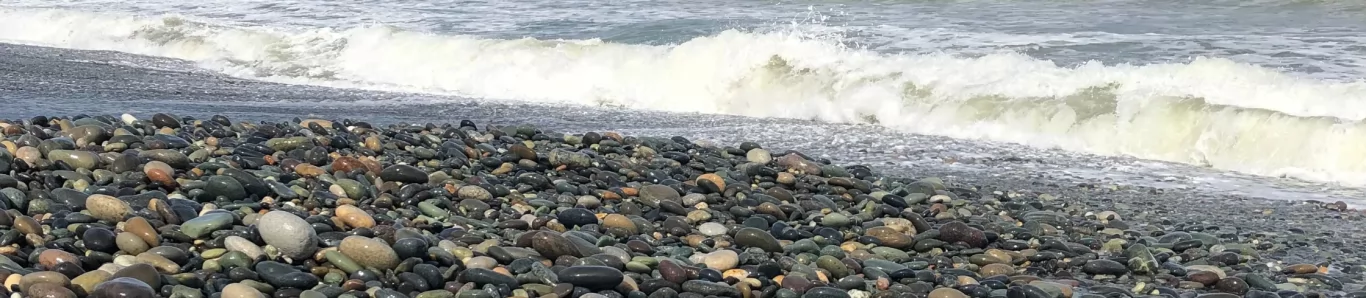
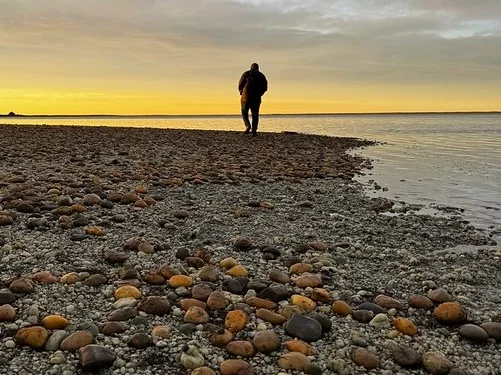
As a member of the Southland Geological and Lapidary Club (SGLC), you can take part in co-ordinated field trips. I think this is one of many great reasons to join (it’s only $30 a year too!), especially if, like me, you’re still learning where to go and what rocks and artefacts can be found in Southland and its surrounding areas.
SGLC holds a field trip on the 4th Sunday of every month. We meet to carpool at the Burt Munro Memorial Statue in Queen’s Park, Invercargill. When the trip heads Invercargill way, it’s an early start for me. I left at 6:30am to arrive on time for this month’s trip. We met a little earlier than usual because high tide at Awarua Bay was scheduled for midday. The sunrise—especially over Riverton—was spectacular and made the early start more bearable. Despite the dramatic sky, the weather stayed overcast and slightly chilly, so I layered up with thermals and a beanie. Rain was forecast for later, but luckily it held off during our time at the bay.


I’d never been to Awarua Bay or Tiwai Point before, so this was uncharted territory for me.
To reach Awarua Bay, you head south to Bluff on State Highway 1, then turn left onto Tiwai Road. Awarua Bay Road branches off to the left, and from there you follow it to the bay. A couple of off-road spots are available for parking; we stopped near a jetty that’s also a popular site for Aurora photographers.
We hoped to find petrified wood, ventifacts, and jasper or quartz. Jenni, one of our members, found a great ventifact with a distinct Y-ridge and clear wind-faceting, plus a piece suspected to be petrified wood. I wish I had taken a photo of that ventifact—it was triangular, like the one I’ve linked below, and looked awesome. Before this trip, I had no idea what ventifacts were or how they looked until Jenni explained it.
According to Puke Ariki
Although ventifacts look like they have been shaped by hand, the word ventifact translates as “formed by the wind”. The stones are sandblasted by winds from several directions to create their pyramid shape. Only a few places in the world have the right conditions to create ventifacts.
Iron-stained quartz is common in Southland, including Invercargill. Many rocks at Awarua Bay had that typical brown or reddish-brown tone, which helped other colours stand out—though the overcast light wasn’t doing us any favours! Higher up the bay, I spotted a rock with what looked like waterlines. I bagged it, thinking I’d slice it one day. I also picked up another fascinating stone (A)—iron-stained with patterned ridges. I’ve decided not to cut or tumble it. It’s now on my display shelf in the stone shed window.
After a good hunt for rocks, we decided there was still time to check out a nearby spot at Tiwai. Even without the club’s gate pass, there’s a publicly accessible area just before the main gates. We parked on the grass and walked to the Tiwai Point Conservation Area.


Tāne, one of our very knowledgeable members, shared artefacts he found (and returned). He showed us pieces of argillite sourced from Colyers Island (light grey) and from Tiwai (darker grey). He also pointed out an old umu site marked by exposed charcoal and broken rock in the cliff along the bay’s edge. It wasn’t the main umu, he explained, likely just a smaller one closer to the shoreline. Tiwai is a significant cultural site for Māori of southern Aotearoa—a key location for crafting stone tools. Tāne’s upcoming work in Dunedin includes cataloguing and helping return artefacts from the area back to Tiwai.
The tide came in while we were there, limiting our space to explore, but it was still a fascinating area for fossicking. Iron staining at Tiwai wasn’t as strong as at Awarua Bay, but the site had its own unique features.
The following Tuesday, I fired up the wet tile saw and cut some of the finds (B). I didn’t collect much at Tiwai, so most of the slices came from Awarua Bay. That waterline stone (C) got sliced in half. Using my old drill with a velcro pad attachment, I worked through the diamond pads (50, 100, 200, 600, 800, 3000) to polish the faces. Though it doesn’t match the finish of a CabKing or Flat Lap, the polished halves turned out better than I expected. The inside was a real surprise!


The other stones I sliced (B) from the trip are already tumbling in F60 grit in the QT12 Tumbler. With any luck, they’ll be ready for Stage 2, 3, and polish in the vibe tumbler in about ten days.
Leaving home at 6.30am!! You are keen. And well worth it.